-->


Translate

Showing posts with label Recursion. Show all posts

Difference between iteration and recursion c++ example

Leave a Comment
Major difference and similarities between recursion and iteration
  • Both works repeatedly, iteration uses loops and recursion uses functions call 
  • Both have termination cases one has a relation expression in loop and one has a base case in if conditoin
  • Iteration checks repeatedly its relational expression and recursion checks repeatedly its base case
  • Iteration control by counter variable and recursion by its base case
  • Both can be run infinitely when loops condition never false and base case if condition never becomes true

Memory differences
In case of recursion every calls put on stack and save into memory the more calls more memory consumption. In worst case if base case never becomes true or programmer has forget to write base case it will cause stack over flow and at some point you will see calls has stopped. In case of loop it will run infinitely and never stops.


Which one to choose?
It depends on the requirement both are not superior to each other in every scenario both have their own benefits and draw backs in different conditions.
For example if you want to write the Fibonacci series program in c++ using loop then it may 
  • hard to write  
  • less overhead to memory 
  • less readable
If you use recursion function code 
long fib(long n) {
    if (n <= 1) return n;
    else return fib(n-1) + fib(n-2);
}

(See example at StackOverFlow.com)
It looks 
  • More readable
  • High memory consumption 
  • Easy to write if you have the good concept of recursion
Read More...

Recursive function in c++ programming

3 comments
This c++ tutorial contains
  • What is a recursion?
  • What are its important parts
  • A simple example code
  • How it affects stack
Recursion in c++ programming 
It is one of the most annoying or difficult concept for c++ programming for beginners. Yes it is difficult for a beginner to understand because sometimes its execution goes in depth where things becomes complicated and a beginners feel difficult to understand it.
A function calls it self until a certain condition is true

A recursive function has two important parts
1. Base case, Stopping state, stopping condition
2. Functions call its self with a specific conditions (Recalling condition)

When a function calls occur in a program it pushes into the stack. So if a function is calling itself again and again (Recursive Calling) it will be pushing again and again on the stack every time it will push new resources will be allocated for a new call.

Base Case:

Its a condition when it becomes true or executes function stop to call it self

Recalling Condition:
A condition in which function recalls it  self with a specific parameters or it depends on the required result we want to get.
  • Lets write a simple example to understand the how recursive function works.
  • In this example an integer 'n' is passing to a function in which its value is incrementing by one in recalling condition.
  • When its value becomes 11 or greater than 10 (base case) it returns all calls.


#include<iostream>
using namespace std;
void recursive_function(int n){

       if(n>10)   //base case 
           return;
      else{
           cout<<"Recursive Function call number "<<n<<endl;
           recursive_function(n=n+1)// here function is calling it self
          }
}
int main(){
  int n=1;
  recursive_function(n)// function call
return 0;
}

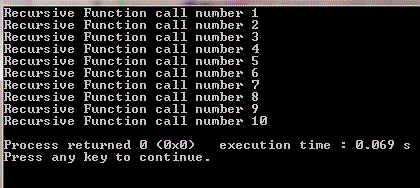
Its output:
Recursive function in c++ programming sample output of the code


Lets have a look to this program it has a problem what


#include<iostream>
using namespace std;
void recursive_function(){
       cout<<"I am Recursive Function"<<endl;
       recursive_function()// here function is calling it self
}
int main(){
  recursive_function()// function call
return 0;
}

When we run the above code our program get crashes why?
When a function is called it puts on to the stack. In the above program function is calling itself again and again and putting its calls on the stack again and again where stack is reserving some resources for each call.
So the stacks are not in large size and when stack becomes full our program get crashes. This is why because there is not a base case in program where function will stop putting itself on stack.


It is recommended to understand the concept do experiment with the code and analyze the output and also dry run the code on paper.  Another example in c++
Read More...